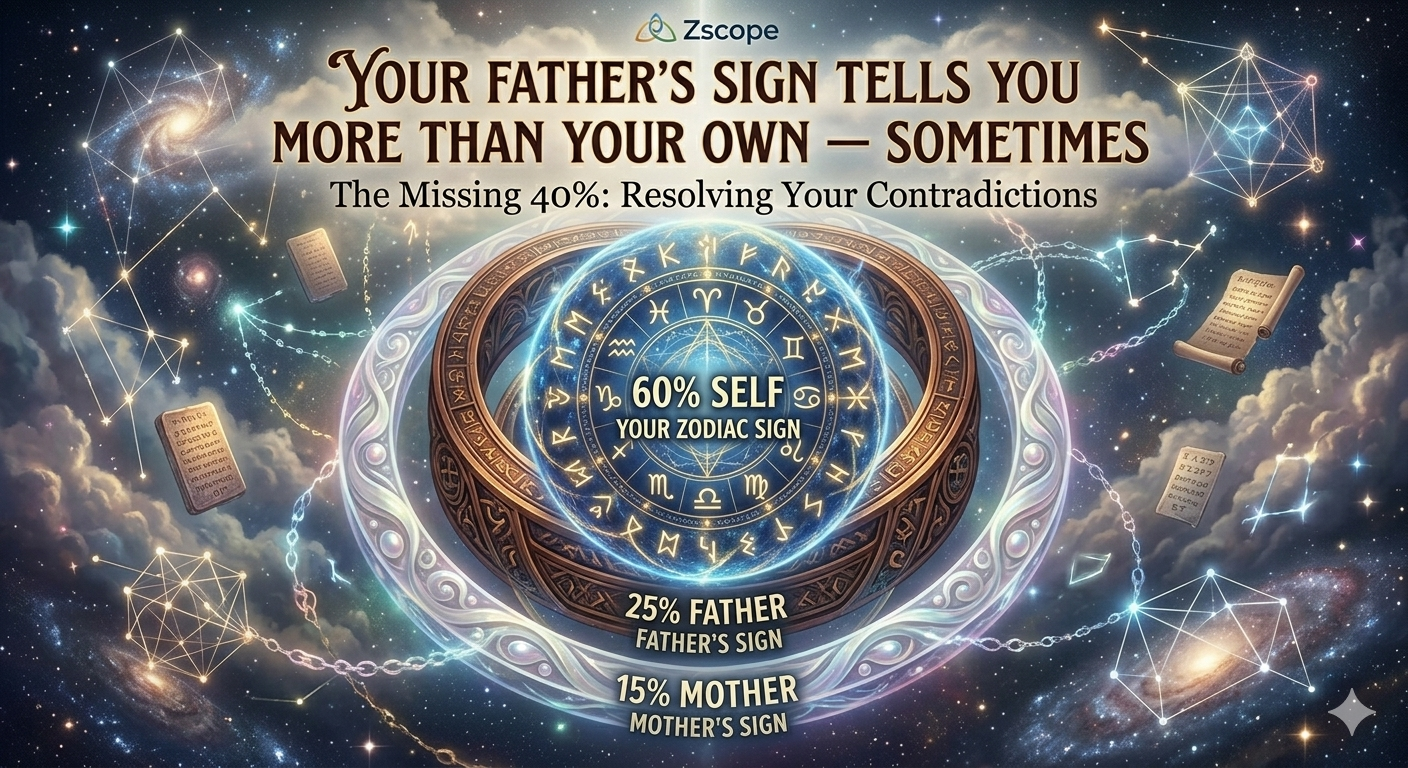
Why Your Father's Sign Tells You More Than Your Own — Sometimes
Your own zodiac sign is only 60% of the story. The remaining 40% — split between your father's and mother's signs — often explains the things you can never quite reconcile about yourself.
If you have ever read your sun sign and thought most of this fits, but the loud parts feel wrong, you are not failing astrology. You are reading an incomplete equation.
Zscope's central design choice is that personality is a function of three inputs, not one: your sign (60% weight), your father's sign (25%), and your mother's sign (15%). The 60% explains why your sun-sign reading rings half-true. The other 40% is what most personality content quietly leaves out — and it is usually the half that explains the contradictions.
Why parental signs at all
The framework's premise is not that your father literally transmits his birth sign to you genetically. It's that the role each parent plays in your formation maps cleanly onto the elemental and modal logic of their sign. A father with a Capricorn structural orientation forms a different kind of pressure on a developing self than a father with a Pisces one — regardless of whether they share a birth month or live two thousand miles away. The sign is a shorthand for a pattern of presence (or absence).
Father's sign weighs more than mother's in the framework — 25% vs. 15% — for a specific reason: the father pattern tends to express more outwardly in adult identity (how you relate to authority, structure, ambition, public facing), while the mother pattern tends to express more inwardly (emotional baseline, attachment style, what you do when alone). Both matter. Both are weighted. The father's contribution is just slightly more visible from the outside, which is why it explains more of what people see in you.
What this looks like in practice
Take a Virgo self with two different parental configurations:
Virgo · Father Capricorn · Mother Cancer Earth-heavy, structurally reinforced. The Virgo precision compounds with the Capricorn discipline; the Cancer mother adds a private emotional anchor. This profile tends to read as steady, competent, slightly reserved — the person whose calendar is meticulous and whose home is a sanctuary.
Virgo · Father Sagittarius · Mother Aries The same Virgo self, but with Fire scaffolding underneath. The Sagittarius father introduces a horizon-seeking pressure that pulls the precision outward; the Aries mother adds a tempo that shortens the runway between thought and action. This profile reads more restless, more verbal, more likely to leave the country on short notice — even though, technically, the "core" is the same Virgo.
These are not two readings of the same person filtered through mood. They are two different deterministic types — different profiles, different growth edges, different compatibility patterns — produced by the engine because the inputs are different.
"But what if I don't know my father's sign?"
This comes up. Three reasons it might:
You weren't raised by your biological father. Use the sign of whoever filled the structural role in your life. The framework is about formative presence, not genetics. If two figures shared the role, run both readings and see which lands.
You don't know your father at all. The diagnose flow accepts an "unknown" path. The reading you'll get is partial — explicitly so. We will tell you which sections we cannot infer without that input. Some self-knowledge is recoverable without it; some isn't.
You know but it feels disloyal to "use" the sign. Reading the structural pressure a person exerted on your formation is not the same as making a moral judgment about them. The framework is not a verdict.
What to do with this
If your sun-sign reading has always felt 60% accurate, that's because it is. Run the full Zscope diagnosis (free) and pay attention to the way the parental modifiers change the picture. The diagnosis page returns your type immediately. The premium report goes deeper into the parental blueprint — what each parent's sign added, what cost each addition came with, and how those compounding pressures show up in adult relationships and work.
You may have always been reading the wrong 60%. The other 40% is the part that explains the rest.
Next in this three-sign-weight series: Why Your Mother's Sign Shapes the Self You Don't Show Anyone Else — what the smaller 15% does that the bigger 25% can't.